 |
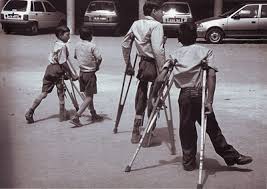
Polio present in only Nigeria, Afghanistan and Pakistan
|
 |
| 1985 Rotary International launches PolioPlus, the first and largest internationally coordinated private-sector support of a public health initiative, with an initial pledge of US$120 million. |
- An Egyptian (1580 – 1350) painting has showed a prehistoric illustration
of a man with polio type lower limb deformity
- In 1773 Sir Walter Scott was presumed to stricken “a severe teething
fever which deformed his limb. This may be the earliest description of
poliomyelitis.
- In the 1900s poliomyelitis assumed an epidemic status,
- Michael Underwood
(1789), Jakob Heine (1840) and Karl Oskar Medin (1890) were the scientist first to study and describe the
disease.
- The first major polio outbreaks were in early 1900s
affecting the USA and Europe.
- 1931 Sir Macfarlane Burnet and Dame Jean MacNamara identify
several types of poliovirus, known as types 1, 2, and 3.
- 1948 Thomas Weller and Frederick Robbins successfully grow
poliovirus in live cells in 1948. Six years later they receive the Nobel Prize
for their work.
- 1955 Dr Jonas Salk develops the first vaccine against polio
– an injectable, inactivated (killed) polio vaccine (IPV).
- 1961 Dr Albert Sabin develops a "live" oral
vaccine against polio (OPV), which rapidly becomes the vaccine of choice for most
national immunization programmes in the world.
- 1974 The World Health Assembly passes a resolution to create
the Expanded Programme on Immunization (EPI) to bring vaccines to the world's
children –
- 1985 Rotary International launches PolioPlus, the first and
largest internationally coordinated private-sector support of a public health
initiative, with an initial pledge of US$120 million.
- 1988 The World Health Assembly passes a resolution to
eradicate polio by the year 2000. The Global Polio Eradication Initiative is launched.
–
- 1991 The last case of wild polio occurs in the WHO Region of
the Americas. He is a three-year old boy called Luis Fermin Tenorio living in Junin,
Northern Peru.
- 1994 The WHO Region of the Americas is certified polio-free.
In China, 80 million children are vaccinated. –
- 1997 The last case of wild polio occurs in the WHO Western
Pacific Region. She is a 15-month-old girl called Mum Chanty living near Phnom
Penh, Cambodia.
- 2002 The WHO European Region is certified polio-free. 500
million children are vaccinated in 100 countries.
- 2003 In northern Nigeria, polio immunization campaigns are
suspended following unfounded rumours regarding the safety of the polio
vaccine. Subsequently, a new outbreak occurs.
- 2006 Four endemic countries remain: Afghanistan, India,
Nigeria and Pakistan Outbreaks in Yemen and Indonesia – which suffer the
largest, single-country outbreaks in recent years – are successfully stopped.
- 2008 A new outbreak of polio spreads from Nigeria to West
Africa. Polio eradication becomes the World Health Organization’s "top operational
priority".
- 2009 The new bivalent oral poliovirus vaccine is used for
the first time in Afghanistan.
- 13 January 2011 India last case of wild polio was recorded. In
20014 India was declared Polo free.
- In 2014, only 3 countries (Afghanistan, Nigeria and
Pakistan) remain polio-endemic, down from more than 125 in 1988
Polio is one of the diseases that strike fears in parents
whose children live in endemic areas, partly because it is lethal and also because
it can leave a residual deformity.
The polio virus may not be as lethal as
Ebola, Lassa, Marburg, Rabies and Bird Flu, but it is of public health and
moral significance because it is amongst the most vaccine-responsive disease.
Like small pox, poliomyelitis should be history.
History of the Poliomyelitis
 |
| Jonas Edward Salk (October 28, 1914 – June 23, 1995) was an American medical researcher and virologist. He discovered and developed the first successful inactivated polio vaccine. He was born in New York City to Jewish parents |
 |
Albert Bruce Sabin (August 26, 1906 – March 3, 1993) was a Polish American medical researcher best known for having developed an oral polio vaccine.
|
 |
Polio eradication is a top priority of the Bill & Melinda Gates Foundation. As a major supporter of the GPEI, They contribute technical and financial resources to our GPEI partners to accelerate efforts to eradicate polio. Many of these strategies are proven, such as targeted vaccination campaigns, community mobilization, and stronger routine immunization efforts. They are also working with partners on innovative ways to enhance polio surveillance and outbreak response, accelerate the development and use of safer and more effective polio vaccines, and galvanize financial and political support for polio eradication efforts from both donor and polio-affected countries.
 |
| 24 0ctober every year is World Polio Day set aside to raise awareness as the world tries to eliminate polio |

Rotary Club of Asokoro Nigeria engages communities and provide fund, skill and time for polio eradication
|

